How much can I spend?
One after-tax number you can spend each year, and how long your money lasts.
Smart Withdrawal plans your RRSP, TFSA and savings withdrawals around CPP, OAS, GIS, RRIF minimums and every tax bracket.
Free · no signup · no names or account numbers
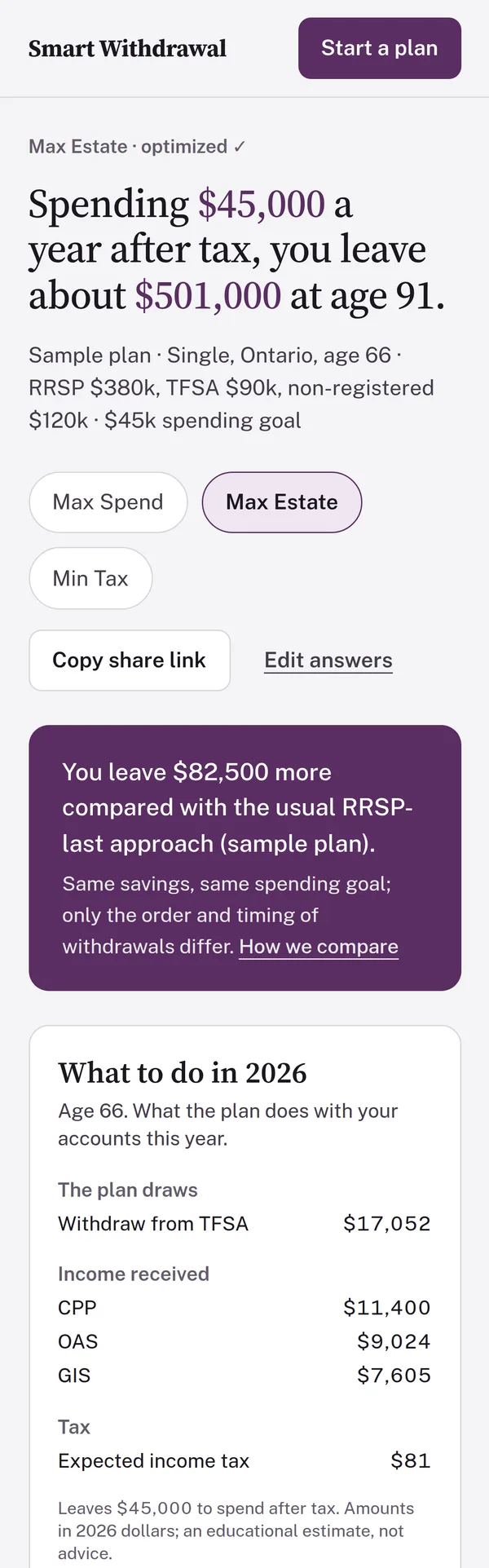
In our sample plan, the optimized order leaves $82,500 more than spending RRSPs last.
Sample plan: single, Ontario, age 66, $590k saved
One after-tax number you can spend each year, and how long your money lasts.
A year-by-year order for your RRSP or RRIF, TFSA and non-registered savings.
Start-age pairs ranked by your goal, with the best one applied in a click.
RRIF withdrawals timed to keep income under the clawback line and shrink the tax on your estate.
Starting later pays more each month but starts later. Drag the sliders to see which start age has paid you the most by any age.
Not sure? $900 is about average. Your My Service Canada Account shows yours.
Every payment counted once, in today’s dollars.
Starting at 70 catches up with starting at 65 at about age 80, and with 60 at about age 78. Starting at 65 catches up with 60 at about age 74.
CPP alone, before tax, in today’s dollars. Delayed past 65, CPP keeps pace with wages (assumed 1.1% a year above inflation) until it starts, then rises with inflation. It leaves out OAS, GIS, tax and your savings, which can change the answer. Educational estimate, not advice.
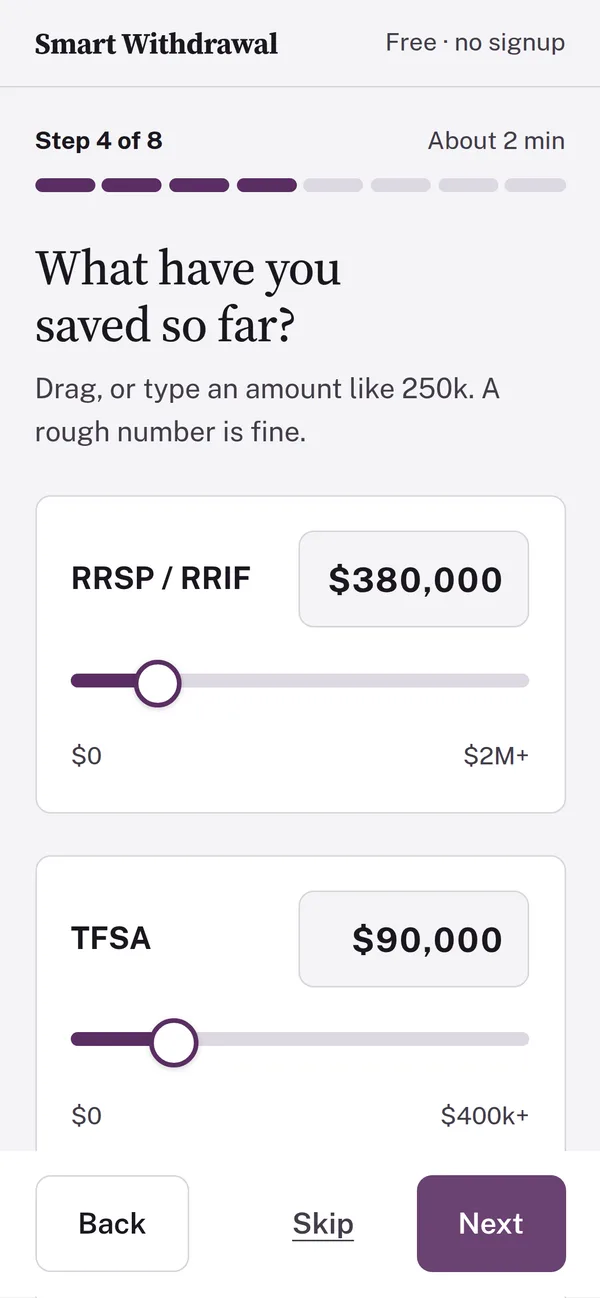
Province, age, savings, income and what matters most. Drag a slider or type a rough number. About two minutes.
Which account pays each year, around CPP, OAS, GIS and RRIF minimums, with a plain reason for every move.

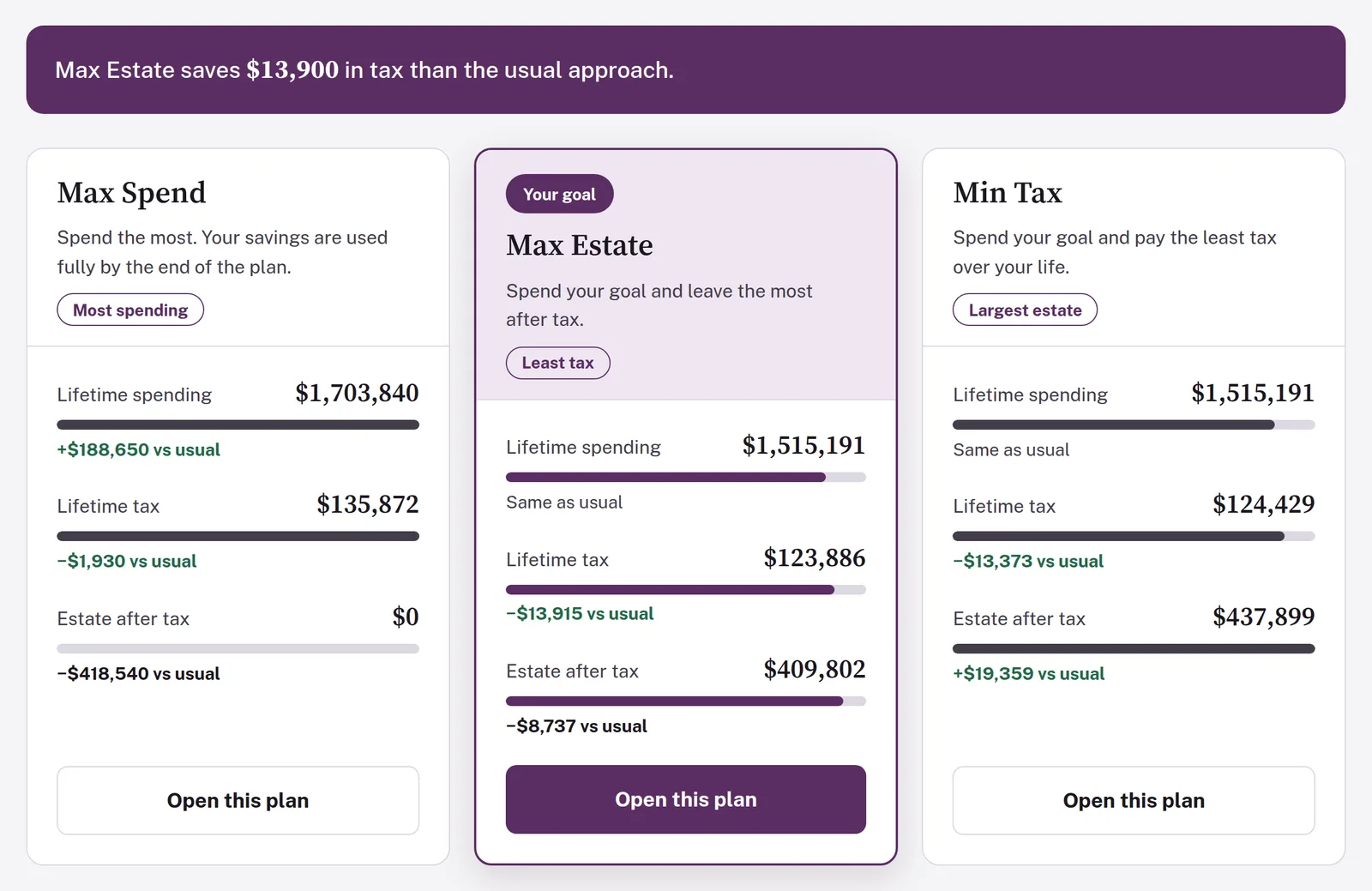
Max Spend, Max Estate and Min Tax side by side, each measured against the usual RRSP-last approach.
No signup, no email, no paywall.
Fed the same yearly withdrawals, our tax and benefit arithmetic matches an independent commercial planner to within 1% of lifetime tax on 46 of 51 test plans.
No names, email or account numbers. Nothing you enter identifies you.
Each plan explains why money comes out of each account, with your own numbers.
Ontario, BC and Alberta. CPP, OAS, GIS, RRIF minimums and TFSA rules, with 2026 tax brackets.
Smart Withdrawal is a side project by a Canadian actuary with more than ten years of experience in insurance.
Retirement income is an optimization problem. Which account you draw from, when you start CPP and OAS, how you stay under the OAS clawback and how much tax is left at death all affect each other, yet most tools follow one fixed rule. I built a spreadsheet model that searched for the best order instead. Later, with the help of AI coding tools, I rebuilt it in Python and put it online so anyone can use it.
It’s free, it doesn’t know who you are, and its tax arithmetic is checked against an independent commercial planner. If you find a mistake, I want to hear about it: hello@smartwithdrawal.ca.
Nothing. It’s free and there’s no signup.
Ontario, British Columbia and Alberta, for singles and couples.
RRSP and RRIF, TFSA, non-registered savings, salary, workplace defined-benefit pensions, CPP, OAS and GIS.
The tax and benefit arithmetic has been checked against an independent commercial planner (see above). The plan itself is only as good as its assumptions: it uses steady yearly returns, not market swings, and 2026 tax rules indexed to inflation.
No. It’s an educational estimate. Talk to a licensed professional before acting on it.
Your numbers are used only to calculate your plan and are never stored with anything that identifies you. Saved plans stay in your own browser.